Summary
This video transcript features attorney Brett Harrison outlining critical strategies for establishing liability in New York traffic accidents, particularly when a police report, which is often non-definitive, fails to tell the whole story. The source highlights the limitations of official reports and the inherent bias in driver testimonies, emphasizing that insurance companies often default to a 50/50 fault split without further evidence. To overcome these disputes, the author identifies independent witnesses and video surveillance from dash cams or neighboring businesses as superior tools for uncovering the truth. Furthermore, the text advocates the rapid deployment of private investigators and accident reconstruction experts who can use physical evidence to disprove false claims. Ultimately, the guide serves as a strategic roadmap for victims to protect themselves legally by acting quickly to secure diverse forms of evidence before they disappear.

- Free Consultation
- A proven record of strong case results
- Personal attention to every client
- No upfront costs to get started
FAQs:
Why is the police report not the final word on who is at fault?
Police reports in New York are often considered non-determinative because the responding officer typically did not witness the accident firsthand. The report presents the officer’s conclusions based on a post-accident analysis and driver statements, rather than an eyewitness account of the collision.
What does “comparative negligence” mean for my New York accident claim?
Comparative negligence is a legal standard in New York under which liability for an accident can be divided among multiple parties based on each party’s percentage of fault. This means that even if you are partially responsible for a collision, you may still be eligible to seek compensation, though the amount is adjusted based on your level of responsibility.
Why are independent witnesses important in a car accident case?
Independent witnesses provide high credibility to a claim because they generally do not have a personal relationship with the drivers involved. Their statements can help clarify conflicting “he-said, she-said” accounts between the parties and the insurance adjusters.
Are witnesses required to stay at the scene until the police arrive?
No, witnesses in New York are not legally required to wait for law enforcement to give a statement. It is beneficial to collect a witness’s name, phone number, and email address immediately, as they may leave the scene before an officer can document their information.
How can a dash cam help in a car accident investigation?
A dashboard camera provides visual evidence that can protect a driver against scams and false claims made by the other party. This footage acts as an objective observer, showing the specific maneuvers and impacts that occurred during the incident.
- Dedicated to protecting your rights
- Focused on getting you fair compensation
- Millions recovered for injured clients
- Experienced in dealing with insurance companies
Transcription of the Video
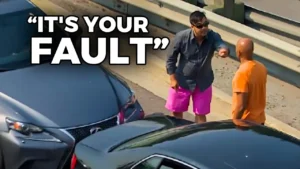
After a car accident, figuring out who’s at fault is not as simple as it seems. One wrong or missing piece of evidence could make all the difference. All the difference to the point of you finding yourself stuck with the bill, and you could be deemed at fault. There are five key steps to uncovering the truth after an accident. Also, there’s a surprising source of footage that many people seldom check. I’m Brett Harrison, a personal injury attorney who has handled thousands of cases. In this video, I’m going to break it down for you and show you why the police accident report isn’t the final say on who’s at fault or on how much you’re ultimately going to receive.
When an officer fills out a police report, it’s very important to understand that the officer typically did not witness the accident. So it’s only conclusions based on a quick analysis of what’s happening: did the person go through a red light? Was there a citation issued? Often, a citation is not issued because the officer did not observe the car accident. But remember, an officer is human also. Maybe they had a bad day, maybe they’re tired, maybe they’re in a rush; they just want to fill out this police accident report. So it’s not consistently determinative because, as I said, officers all fill it out differently.
A police report there’s a section here that says accident description/officer’s notes. Some officers just write “vehicle one and vehicle two got into a collision”. Other officers will list what each driver said in this. So it’s all over the place. But what’s frequently overlooked are these grids over here. These numbers tell another story, but that’s for another video. Just remember the police report it’s not the be-all end-all. It’s not bulletproof.
We’re going to talk further now about other forms of evidence that can help you. Second point that helps determine liability: I call it the “you say, they say”. That just means each driver’s version of what they tell their insurance company. But that’s not frequently dispositive of who caused the accident because it’s recollections of what each driver saw or thought they saw,. It’s not necessarily that they’re lying; it’s just their perception of what happened. Maybe they weren’t paying attention, maybe they were looking down, or maybe they were only looking straight ahead, not to the sides to see what was around them.
Now getting back to that “you say, they say,” insurance companies sometimes they like to say, “Well, my insured said X, your insurance says Y. You know what? Why don’t we just do it 50/50 if it’s not dispositive either way?” Well, that’s not consistently the case. Why? Because there are other forms of evidence. But before we get to that, I want to let you know that in New York we have comparative negligence that each side could be partially at fault or a percentage at fault.
Now I’m going to discuss a real live situation that I’m currently, and my office is currently, handling. It’s exactly the he-said-she-said. In this case, my client was driving. He’s going straight a road he’s consistently been on on his way to work early morning, lights are on. What happens? All of a sudden he’s faced head-on with this other driver and big crash. His car is totaled. Her car is totaled. Airbags come in the face, and the police wrote “vehicle one and vehicle two got into a car accident.” Officer didn’t see the accident; only came after the fact. My client said, “She turned into me or she came into my lane; I had nowhere to go.” She said, “No, I don’t know what happened, all of a sudden he came and hit me”.
So initially what happens is the insurance adjuster for the defendant said, “I see it as 50/50.” So what can happen? Well, it can go in an arbitration where you have a neutral party that decides the liability. But hold on, put on the brakes. There’s more that we can do. Now we’re going to go to the next secrets that will move us past the 50/50, and that’s what happened in this case which I can’t wait to share with you.
Now we’re going to talk about witnesses. Witnesses are very important because a witness generally doesn’t have a dog in the fight. So that means basically the insurance company puts a lot of credibility in a witness’s statement. However, before the witness can be given credibility, we have to look at a few things. One, is the witness somebody’s cousin, brother, sister, whomever it may be somebody they know? Let’s talk about like in my case; there was no passenger in either car. So in this case, there was a witness. But now back up again: what did the witness see and when did the witness see it?
Now in this case, the witness I don’t know if they spoke with the police officer. In this case, it doesn’t appear to be because the witness wasn’t listed on the police report, which is not unusual. Sometimes a witness will stay for a little bit and then they’re like, “Listen, I got to go.” But in this case, the witness was very helpful. While my client was speaking with the witness, my client was smart enough or aware enough to ask the witness, “Can I collect your name, your phone number, your cell, your email?” So we received that, put it in his pocket.
So we then contacted the witness and what did the witness say? “I didn’t actually see the accident; I saw the aftermath. In other words, I heard a big crash and then I saw it”. So the witness didn’t actually see the accident happening. So it was kind of a very limited usage for us. The witness could be impactful for the sense of describing the impact, how they heard it, that it was a large crash. And also the witness could be helpful if they spoke to either the police officer and the officer didn’t write down witness’s name, address, and information, or if the witness spoke with either of the parties involved in the accident, that would be helpful and that could be used as evidence.
In this case, really didn’t speak to either of the witnesses except my client saying, “Hey, here’s my number and my phone number.” I believe he said, “I have to leave; I got to arrive at work. If you need anything please contact us”. We did contact them. One important thing to note: a witness is not legally required to wait around for a police officer. So that’s important to note. That’s why it’s very important to collect the information when you can from any potential witnesses. Collect their name, phone number; if you can collect their address, but collect their email. That’s very important because you know what? A witness can make all the difference in a case.
Maybe a witness saw one of the parties texting and looking down or on their phone. Maybe the witness saw somebody go through a traffic device like a light or a stop sign. Maybe the witness may note, “Hey, that person was speeding” or “I heard them screech on their brakes and they skidded”. Or they could note the weather conditions for example, it was raining out and one of the parties in the accident skidded into the other person’s lane, something to that effect. So it’s very important to note when you’re at an accident or in an accident to observe: are there any witnesses? Try to collect all their information soon as possible because sometimes witnesses won’t wait for police officers. And sometimes officers won’t take the time to gather the information or talk to the witness.
Now we’re going to go to point four: video footage or surveillance. And what I mean by that: you have Ring cameras, Nest cameras; you also now have dashboard cams in cars. Now video, you know how they say a picture is worth a thousand words? Well, a video is worth a million words. It could be the deciding factor if you can secure the video surveillance.
Now in the case that I was talking to you about, we had two things in our favor. My client had a dashboard cam, but it was on. Now, what the dashboard cam showed is that a car came and hit him head-on. Well, that was a helpful part of the way. But the problem is it only showed a limited view. So what became important was determining if there was any other video surveillance like the Ring cameras or Nest cameras.
Now, just so you know, private citizens and private businesses don’t have to give you their surveillance videos in any way. They’re not required. Now, as attorneys, of course, you can try to subpoena them, ask the police to canvas the area to go see if there’s any videos, but they’re not generally going to do that, the police officers, unless it’s a catastrophic injury where maybe’s unfortunate death occurs. Otherwise, that’s generally not going to happen. I recommend you secure a dash cam for your car. Why? Because it helps you, God forbid somebody’s claiming you caused an accident or you were involved in an accident and it’s a scam. Once you have that video, you can say, “Oh, really? Where do you see that I hit you?”
So my advice: secure the cam. Also, if you are involved in an accident, scout the area. See if there are any witnesses, and check if there are any other businesses or traffic cameras around. If there are houses on either side or in front, go to those houses. A lot of times if you’re nice, people will say, “Hey, I have that; I have a Ring camera or I have a Nest camera,” or whatever it may be. But remember, this is really important: a lot of times it’ll erase in 24 hours. It could be seven days, 48 hours, everybody’s is different. So you really want to act quickly. That’s very key in this situation.
Fifth and final point: investigators and accident reconstruction professionals. Now, a lot of times you want to hire a private investigator because they can do is; they’re traine,d many of them are former police officers or FBI agents in their prior work. Now, what’s good about them is that they canvass the area and try to collect witnesses. They can also see again: are there any Ring or Nest videos or any type of surveillance, including going to the businesses?
In the case that we were talking about, I happened to hire my investigator right away because people’s memories are optimal, and they’re more willing generally to help if you contact them right away as quickly as possible. In my case, the investigator that we hired for the case was able to secure some video which helped us show the liability was more on the other side, the other party. But it was also very confusing, with roads turning and curving, and the lights. So what my investigator did is he did the route that each of the party said they did during the accident, before and after. And what it showed was that the only way for the other party to strike my vehicle was they actually turned improperly in an area they could not turn. So what we did is once we showed that video to the other side, they actually went from 50% to 100%. But the key was hiring an investigator and acting quickly.
Now you also have accident reconstruction professionals. A lot of times you’ll hear testimony like, “Oh, I was only going 15 miles an hour,” “I was going 10,” “I was going 40 miles an hour.” So, what an accident reconstructionist will do is look at the angles of all of the damage to their vehicles. They’ll inspect both vehicles, review pictures, and then listen to the testimony each is claiming. “I was going 20 miles an hour,” “I was going 30,” or what have you, or “I was braking”. And what an accident reconstructionist can do is, with all their voodoo mathematics and the way they’re trained, they can actually show maybe one party was mistaken or actually lying. And that in and of itself can also help be conclusive.
Now, also, what happens if you find yourself involved in a commercial vehicle? A lot of the time, they have a cam, or they dispatch their investigators to the scene right away. So why shouldn’t you have your investigator there right away? Bottom line: your investigative professional could be your ace in the hole, helping determine liability and making all the difference in your case. We just uncovered the five secrets to determining or helping you determine fault after an accident.